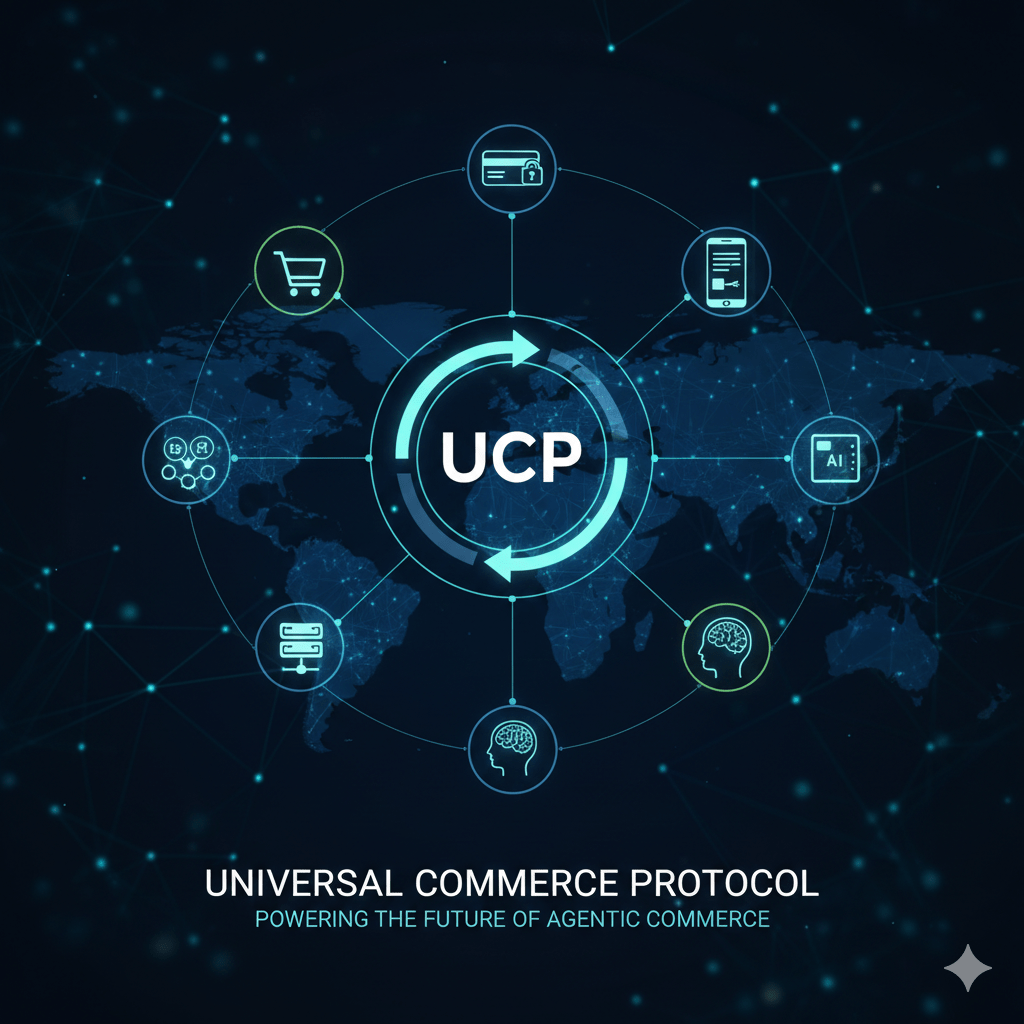

The Universal Commerce Protocol (UCP) is an open-source standard designed to power the next generation of agentic commerce. By establishing a common language and functional primitives, UCP enables seamless commerce journeys between consumer interfaces, businesses, and payment providers. It is built to work with existing retail infrastructure and is compatible with the Agent Payments Protocol (AP2) to provide secure support for agentic payments. Additionally, it offers businesses flexible integration paths via APIs, Agent2Agent (A2A), and the Model Context Protocol (MCP).
UCP is being developed by Google in collaboration with industry leaders such as Shopify, Etsy, Wayfair, Target, and Walmart, and is recommended by over 20 global ecosystem partners including Adyen, American Express, Best Buy, Flipkart, Macy’s Inc, Mastercard, Stripe, The Home Depot, Visa, Zalando, and many others.
UCP is built to benefit the entire commerce ecosystem
- For Businesses: UCP allows you to showcase your unique product and service offerings across shopping touchpoints via consumer interfaces like AI Mode in Google Search, the Gemini app, and others in the future. With UCP, you own your business logic and remain the Merchant of Record. UCP is designed for retailer flexibility, offering an “embedded option” that allows you to maintain a fully customized checkout experience from day one.
- For AI Platforms: With UCP, you can enable agentic shopping for your audiences. You can simplify business onboarding with standardized APIs while giving them the flexibility to use MCP, A2A, and their preferred existing agent frameworks.
- For Developers: UCP is an evolving open-source standard designed to be community-driven. We invite you to join us in building the next generation of digital commerce.
- For Payment Providers: UCP’s open, modular payment settlement design enables open interoperability and choice of payment methods. Through this design, UCP enables provable universal payments. Every authorization is backed by cryptographic proof of user consent.
- For Consumers: When your favorite brands adopt UCP, it removes the friction from product discovery to selection, allowing you to buy the brands you love with peace of mind, ensuring you get the best value, including your membership benefits.
The Case for a New, Flexible Standard
As consumers embrace conversational experiences, they expect a seamless transition from brainstorming and research to the final purchase. This means it is crucial to support real-time inventory checks, dynamic pricing, and instant transactions—all within the user’s current conversational context.
However, traditional technological infrastructure makes it difficult to support this agentic shift. Businesses struggle with an N x N integration bottleneck, forcing them to build custom connections for every interface, which ultimately slows the ecosystem’s shift toward delightful, agentic commercial experiences.
UCP was developed in collaboration with industry leaders and is designed to address this bottleneck and meet the evolving needs of the entire commerce landscape. Unlike legacy systems, UCP standardizes the complete commerce journey—from discovery and consideration to purchase and order management—through a single, secure abstraction layer:
- Unified Integration: Consolidates N x N complexity into a single integration point for all consumer interfaces.
- Shared Language: Standardizes discovery, capability schemas, and transport bindings to ensure cross-platform interoperability and end-to-end support for the full commerce lifecycle.
- Extensible Architecture: Built with flexible capabilities and extension frameworks that can easily scale as new agentic experiences emerge. This design choice also allows UCP to expand into new sectors.
- Security-First Approach: Provides tokenized payments and verifiable credentials as a secure way to communicate between agents and business backends.
By reducing integration complexity and removing technical barriers, UCP enables businesses to actively participate in the new era of agentic commerce.
UCP Overview
UCP is built to offer agentic experiences across the entire commerce ecosystem. It creates a clear language for consumer interfaces (such as AI Mode on Search, Gemini, and others) to connect with business backends (for product discovery, shopping carts, etc.) in a standardized and secure manner.
Businesses and brokers choose the services (e.g., shopping and other sectors) they wish to support and make the corresponding capabilities available. Capabilities are the core building blocks of commerce, such as checkout and product discovery. These capabilities can also have extensions that complement them with specialized functionality, such as discounts. The UCP discovery mechanism allows agents to dynamically discover business capabilities and payment options through profiles.
Additionally, UCP models a unique payment architecture, separating what consumers use to pay (instruments) from payment processors, allowing it to scale across a diverse set of existing payment providers. UCP also supports multiple transports, including A2A, MCP, and APIs, providing flexibility for businesses and agents to communicate. For example, the Checkout Capability can have a REST API binding or an MCP binding, depending on your platform’s needs.