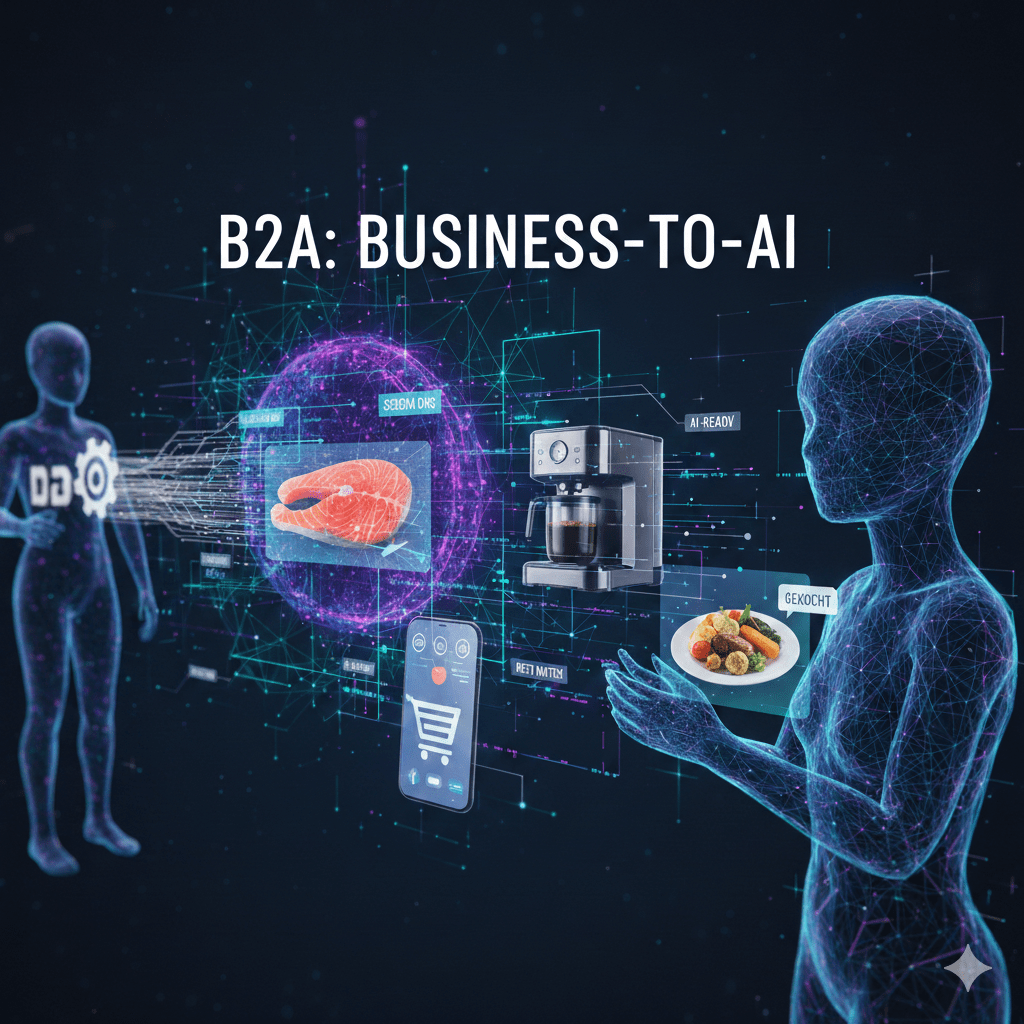

In the world of marketing and e-commerce, we have been trained for decades to think in two flavors: B2B (Business-to-Business) and B2C (Business-to-Consumer). But while we are still busy optimizing the human customer journey, a new, disruptive player has appeared on the field: B2A (Business-to-AI).
Marketing managers are facing a fundamental shift. After all, it’s no longer just people who search and compare your products; they are AI systems that decide which brand the end user will see.
From SEO to GEO: The battle for citation
The evolution of search behavior forces us to transform our strategy. We are rapidly shifting from SEO (Search Engine Optimization) to GEO (Generative Engine Optimization).
- SEO (Traditional): You’re fighting for that coveted blue link on page one of Google. The goal is findability.
- GEO (The Future): You focus on visibility within AI-driven answering machines such as ChatGPT, Perplexity, and Google Gemini.
In the world of GEO, it’s not about „beating“ the algorithm for a position, but about becoming the authorized source. The AI should choose your data as the foundation for its answer. Where SEO is all about discoverability, GEO is all about mentionability and contextual authority.
What exactly is B2A?
Business-to-AI (B2A) describes the interaction in which a company optimizes its data, content, and products to be understood, recommended, and ultimately purchased by artificial intelligence. The „customer“ in this scenario is an AI agent or a personal assistant who makes decisions on behalf of the user.
The power of visual ubiquity
In this new era of B2A, the ubiquity of your own, unique imagery is the key to digital authority. When a brand distributes its imagery consistently and widely across channels and marketplaces, it acts as a powerful training signal for AI models.
AI models recognize patterns; By indexing the same high-quality source files and associated metadata across platforms, you strengthen your brand’s visual footprint. As a result, the AI learns the direct link between your visual identity and specific search intents. The result? Your brand is not only recognized faster by AI-powered search engines, but also presented with higher reliability as the relevant answer to the customer’s question.
The shift in communication: Hard facts over emotion
B2A requires a radically different approach than we are used to:
- From B2C to B2A: In B2C, we seduce the consumer with emotion and design. However, an AI is not tempted by a beautiful banner. For B2A, machine readability is sacred. Think of structured data (Schema.org) and factual accuracy.
- From B2B to B2A: Where B2B sales often rest on personal relationships, B2A automates the pre-selection. An AI procurement assistant scans the market for hard criteria such as price, inventory, and technical specifications.
Why AssetFlow 4 is the key to B2A
For an online platform, B2A is the way to future growth. When a chef asks their AI assistant for the „best sustainable cod,“ the B2A strategy determines who gets the order.
AssetFlow 4, the Ecom DAM, plays a crucial role in this. By perfectly structuring product images and metadata (such as allergens, origin and preparation) through AI-driven workflows, the content becomes „digestible“ for the AI models that dominate the market. You ensure that your brand is not only present, but is seen as the most trusted authority by the algorithms of the future.